
Blog
Our Latest Insights
Explore our latest blog post where we share insights on our design process, from initial ideas to completed projects.
The Complete Guide to eCommerce SEO
eCommerce & SEO
Most online shops are invisible on Google. Not because the products are bad, but because nobody ever did the SEO. This is the complete guide to ecommerce SEO: what it covers, why it matters and where to focus first.
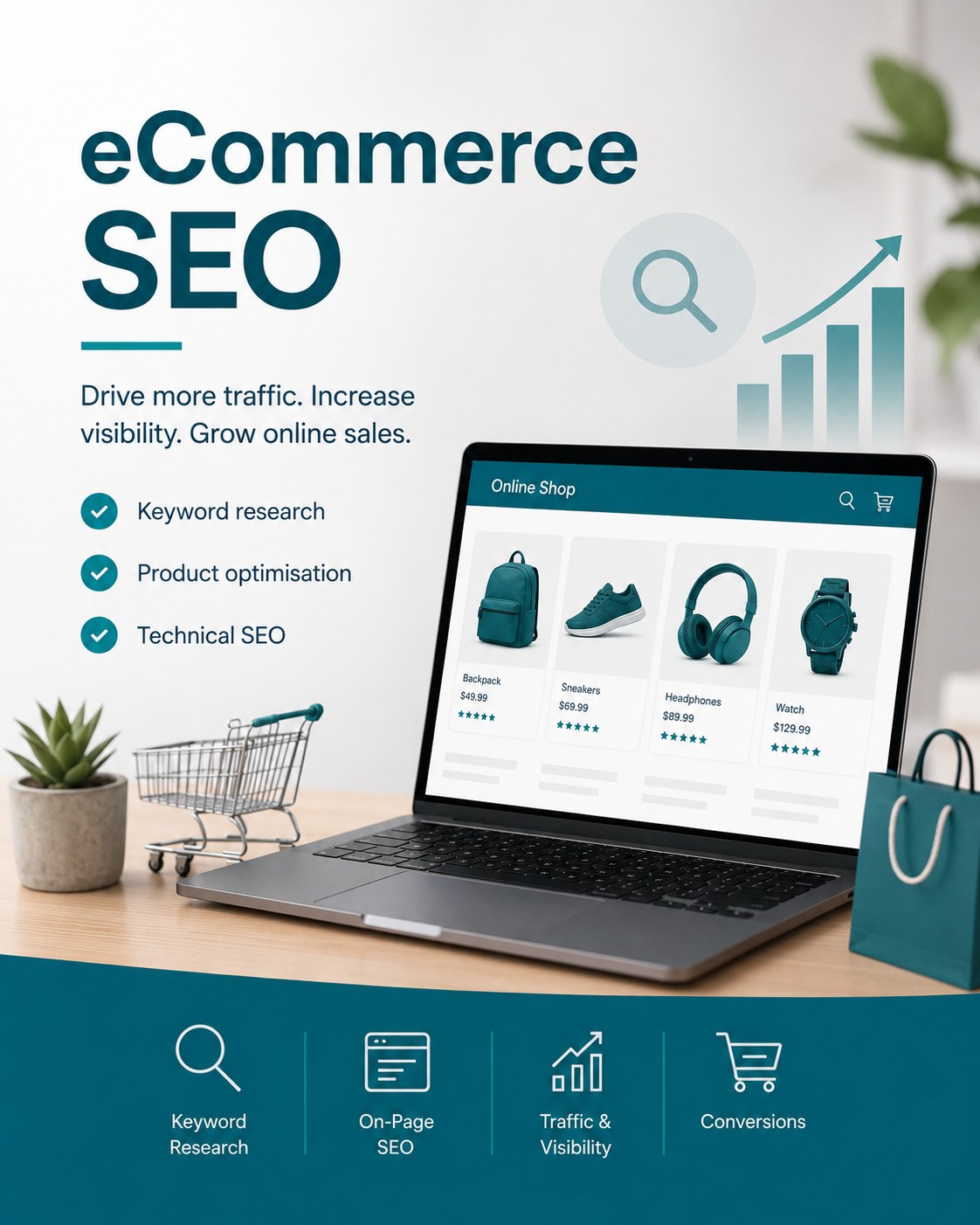
Ecommerce SEO is the work of making your online shop show up in search results when people look for the products you sell. Unlike Google Ads, where traffic stops the moment the budget does, organic rankings keep sending buyers to your shop month after month, at no cost per click.
The good news is that most online retailers neglect it, so the bar is lower than you think. This guide walks through the six areas that make the biggest difference: product pages, category pages, technical SEO, site speed, structured data and internal linking.
What makes ecommerce SEO different?
Standard SEO principles still apply, but an online shop adds scale and complexity. A brochure site might have ten pages. A shop can have thousands of product URLs, filtered category views, out-of-stock items and near-identical descriptions copied from the manufacturer. Search engines have to make sense of all of it.
The intent is different too. Someone searching for a product type is often ready to buy, so every ranking you win has a direct line to revenue. That is why ecommerce SEO consistently delivers some of the best returns in digital marketing.
Product pages that rank and sell
Product pages are where the sale happens, and they are usually the weakest pages on a shop. To make yours work harder:
- Write unique descriptions. Never paste the manufacturer’s copy; hundreds of other retailers have the same text, and Google rewards the original version, not yours.
- Put the keyword in the title. Use the words shoppers actually type, including brand, model and key attribute, in the page title and H1.
- Answer buying questions on the page. Sizing, materials, delivery, returns. If shoppers have to leave the page to find answers, some never come back.
- Use real photos with descriptive alt text. Image search is an underrated source of ecommerce traffic.
- Show reviews. They add fresh, keyword-rich content and the social proof that converts.
Category pages: your hardest working pages
Here is the part most shop owners miss: category pages, not product pages, win the biggest keywords. Far more people search for a product type than for one specific product, and your category page is the natural landing page for those searches.
- Add a short block of unique introductory copy to every category page, written around the category keyword.
- Give each category its own page title and meta description; auto-generated ones all look the same to Google.
- Link from category pages to your bestsellers, and between related categories.
- Keep categories crawlable. Do not hide them behind filters or block them in robots.txt.
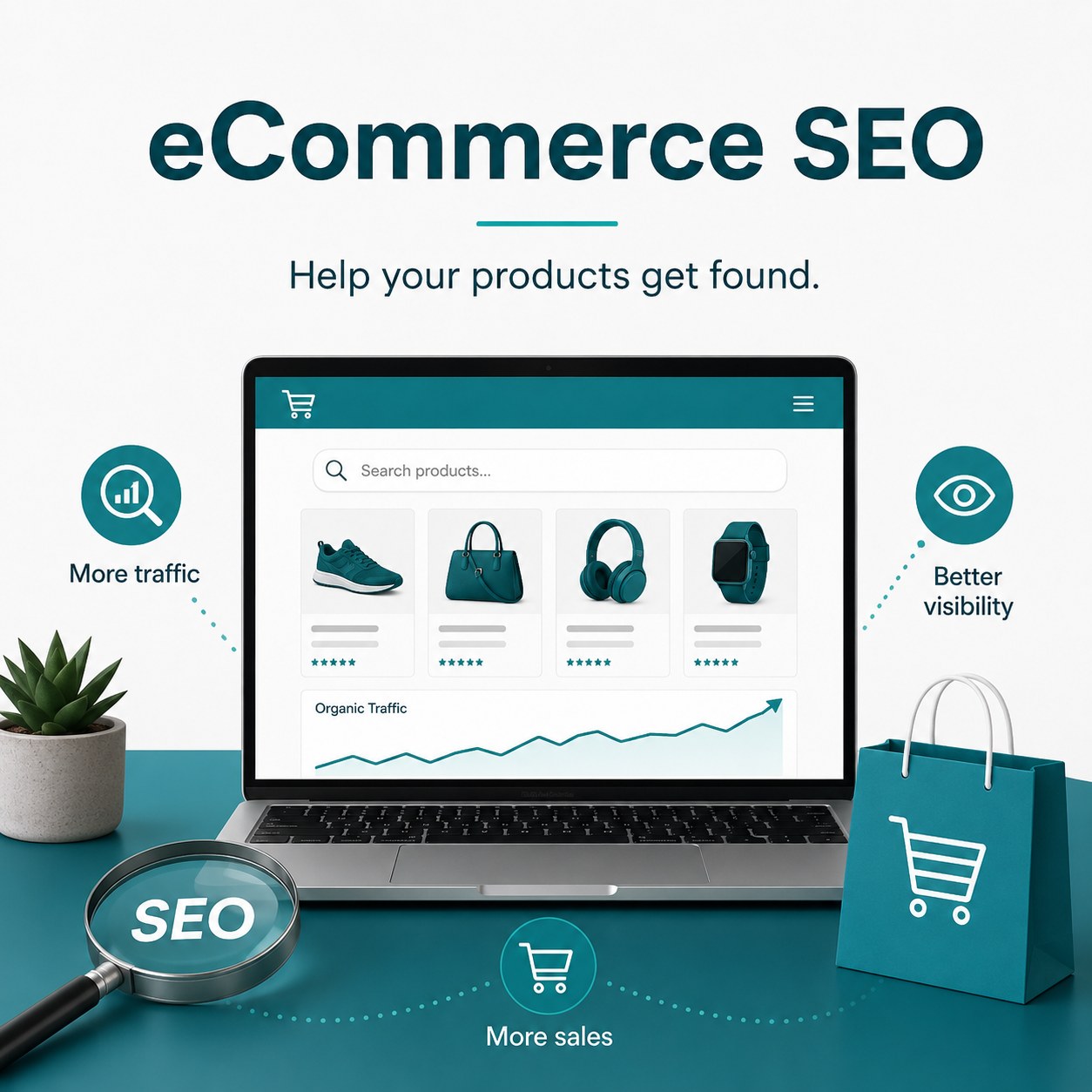
Category pages win the big keywords
Most shoppers search for a type of product, not a product name. A well-optimised category page captures that traffic and passes it straight to your bestsellers.
Technical SEO: make your shop easy to crawl
Technical SEO is everything that helps search engines find, crawl and index your shop without getting lost. On an ecommerce site the usual suspects are:
- Faceted navigation bloat. Filters for size, colour and price can generate thousands of near-duplicate URLs. Use canonical tags so Google knows which version counts.
- Duplicate content. The same product reachable at several URLs splits your ranking signals. Pick one canonical URL per product.
- Out-of-stock and discontinued products. Redirect discontinued items to the closest category rather than leaving a trail of 404s.
- An up-to-date XML sitemap submitted in Google Search Console, so new products get found quickly.
- Clean URLs and HTTPS across the whole site, with no mixed-content warnings at checkout.
Nobody browses to page two of Google. If your products are not on page one, they may as well be in a locked warehouse.Barbara Payne & Sarah Ford, Digital House
Site speed: the silent sales killer
Speed is both a ranking factor and a conversion factor. Every extra second of load time sends a slice of your visitors, and your ad spend, straight to a competitor. Shops are especially prone to slowdowns because of large product images, heavy themes and app bloat.
Compress and resize every product image before upload, remove plugins and apps you no longer use, choose decent hosting, and test your key pages with Google’s PageSpeed Insights. A well-built website gets most of this right from day one, which is far cheaper than fixing it later.
Structured data: speak Google’s language
Structured data (schema markup) is code that tells search engines exactly what is on the page: this is a product, this is its price, this is its star rating, this is whether it is in stock. In return, Google can show your listings as rich results with review stars, prices and availability, which earn far more clicks than plain blue links.
At minimum, every product page should carry Product schema with price, availability and review data, plus breadcrumb markup site-wide. Structured data also helps AI tools understand and recommend your products, which is the heart of answer engine optimisation (AEO), fast becoming the other half of search.
Internal linking: spread authority through your shop
Internal links tell search engines which pages matter most and help authority flow from your strongest pages to the ones you want to rank. On an ecommerce site that means:
- Link your most important categories from the homepage and main navigation.
- Use breadcrumbs on every product page so shoppers and crawlers can move up to the category.
- Add related-product and related-category links with descriptive anchor text, not just “click here”.
- Publish helpful blog and article content that answers buyer questions and links down to your categories and products.
Done consistently, this quietly lifts the whole site. You can see what that looks like in practice in our client work and case studies.
Frequently asked questions
How long does ecommerce SEO take to show results?
Expect meaningful movement in three to six months, with compounding gains after that. Quick wins like fixing titles, adding category copy and repairing technical errors can show up sooner.
Should I invest in SEO or paid ads for my online shop?
They do different jobs. Paid ads buy immediate, controllable traffic; SEO builds an asset that keeps paying after the work is done. Most successful shops run both, then shift budget towards SEO as rankings grow.
Do I need to rewrite every product description?
Start with your bestsellers and highest-margin products, then work through the catalogue in order of value. Unique copy on your top fifty products beats thin copy on five hundred.
Does my ecommerce platform matter for SEO?
Shopify, WooCommerce, Magento and the rest can all rank well. What matters is how the shop is set up: clean URLs, fast templates, proper canonical tags and the on-page work described in this guide.
Want your shop on page one?
Digital House runs ecommerce SEO for online shops of every size, from product page copy to full technical audits.
Explore our SEO services or Book a Discovery Call and we will show you exactly where your shop is losing traffic.
Book a Free Digital Marketing Audit
Our free digital marketing audit reviews how your website, email campaigns, and online visibility work together, and identifies practical steps to improve performance.
Request a Free Digital Strategy Audit

We Take Your Digital Marketing to the Next Level
Find effective digital reach and real conversions for your business, driven by data

100
5 Star Google Reviews
