
Blog
Our Latest Insights
Explore our latest blog post where we share insights on our design process, from initial ideas to completed projects.
Blog
Hits: 34
The Marketing Metrics Every SME Should Review Monthly

Marketing Metrics
We get asked this a lot by business owners: “What should I actually be looking at each month?” Usually because they have a dashboard somewhere with 40 metrics on it, and no real idea which ones matter.
Here is what we get every client to check, every month, without fail. Just five numbers.
1. Cost per lead
Not just “how many leads did we get.” How much did each one actually cost you? If you are a plumber in Basingstoke running Google Ads, you might be paying £35 per lead this month and £52 next month for the same volume. Nobody notices that creep until the budget has quietly doubled.
Check cost per lead monthly. Not annually.
2. Lead to customer conversion rate
Leads are vanity if they do not convert. If ten enquiries come in and only one becomes a customer, that is not always a marketing problem. It is often a follow-up problem: someone not calling back fast enough, or a quote that took a week to land in someone’s inbox. A well-timed email follow-up can fix more of this than another campaign.
3. Customer acquisition cost (CAC)
This is cost per lead’s bigger sibling. It is what it costs you, all in, to win a paying customer, not just an enquiry:
- Ad spend
- Time spent following up
- Any tools or platforms involved
Compare that number to what the customer is actually worth to you, and you will know fast whether your marketing is profitable or just busy.
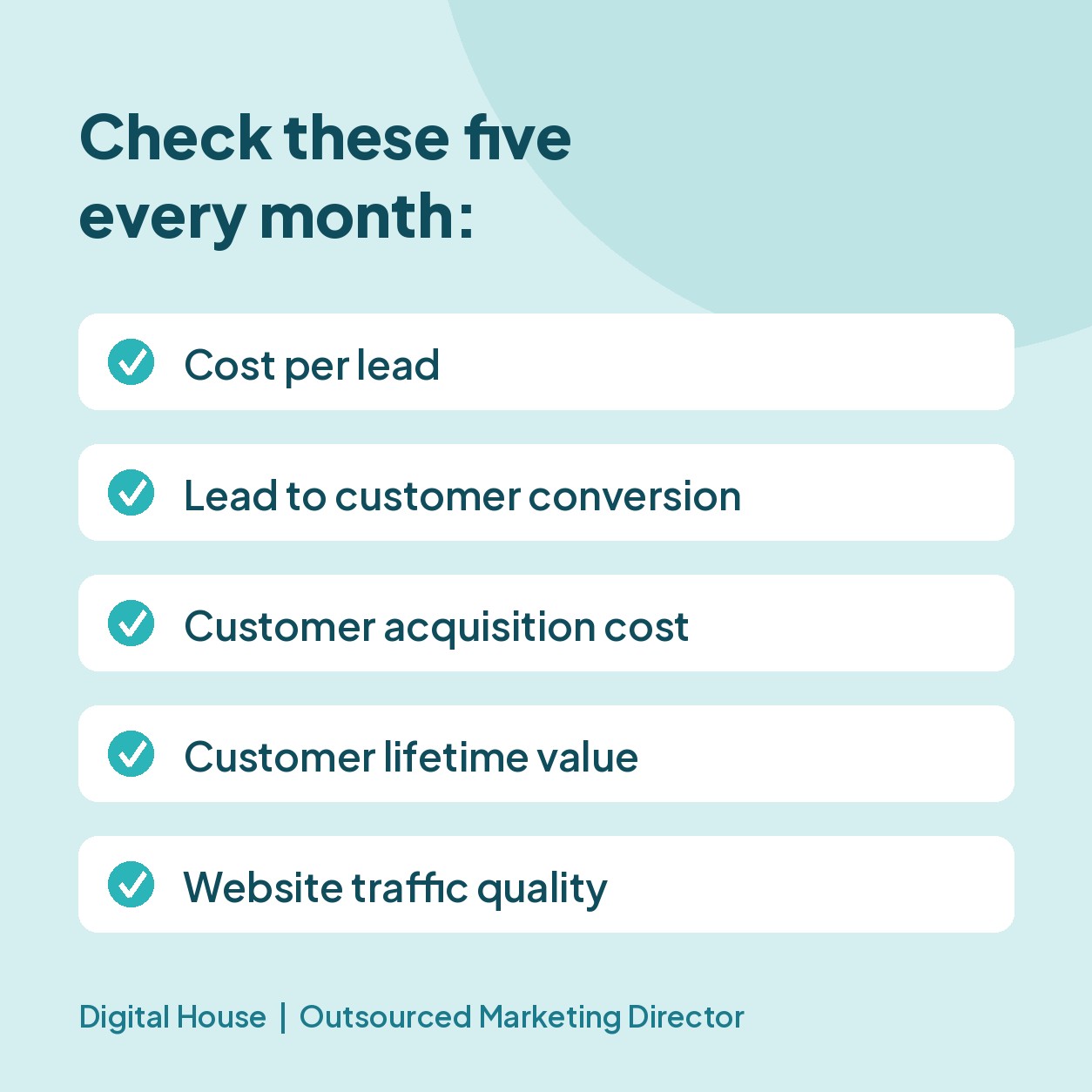
Five numbers, twenty minutes, once a month
Cost per lead, conversion rate, acquisition cost, lifetime value and traffic quality. Together they tell you whether your marketing is making money or just making noise.
4. Customer lifetime value (LTV)
If you do not know this number, you are guessing on everything else. A £50 acquisition cost sounds brilliant until you realise that customer only ever spends £40 with you. LTV tells you what you can actually afford to spend to win someone in the first place.
5. Website traffic quality, not just volume
Forget total visitors. Look at where that traffic is coming from and what it does once it lands. Ten thousand visitors who bounce in five seconds are worth less than two hundred who read three pages and pick up the phone. Good SEO and a website built around the customer bring the second kind. Traffic is a means to an end, not the goal itself.
Twenty minutes a month on these five numbers tells you more about the health of your marketing than any agency report full of vanity metrics.Barbara Payne & Sarah Ford, Digital House
Why this keeps coming up
We see the same pattern constantly. Business owners get busy, marketing runs on autopilot, and nobody checks these numbers properly for months. By the time something is clearly wrong, it is an expensive fix rather than a quick one.
Frequently asked questions
How do I work out cost per lead?
Divide what you spent on a channel in the month by the number of enquiries that channel produced. Do it per channel, not as one blended figure, or a cheap channel will hide an expensive one.
What is a good lead to customer conversion rate?
It varies enormously by sector, but the useful question is whether yours is moving. A falling rate with steady lead numbers almost always points to follow-up speed or quote quality rather than the marketing itself.
How do I estimate customer lifetime value if I do not have the data?
Start simple: average order value, multiplied by how many times a typical customer buys in a year, multiplied by how many years they stay. A rough number you actually use beats a precise one you never calculate.
Where do I find traffic quality figures?
Google Analytics and Google Search Console show where visitors come from, how long they stay and which pages they read. If those are not set up properly, that is the first thing to fix.
Not sure where to start?
If you are not currently tracking these five numbers, or you are not sure how to pull them together from your current setup, that is exactly the kind of thing our Outsourced Marketing Director service sorts out for clients in week one.
Tell us which of these five you do not currently track and we will point you in the right direction. Book your Discovery Call.
Book a Free Digital Marketing Audit
Our free digital marketing audit reviews how your website, email campaigns, and online visibility work together, and identifies practical steps to improve performance.
Request a Free Digital Strategy Audit
Similar Articles


We Take Your Digital Marketing to the Next Level
Find effective digital reach and real conversions for your business, driven by data

100
5 Star Google Reviews
